
Appearance
Configuration Reference
See also: Oceans LLM Gateway, Runtime Bootstrap and Access, Identity and Access, Service Accounts, Model Routing and API Behavior, Pricing Catalog and Accounting, OIDC and SSO, ADR: Configurable Admin Page Permissions
This page owns config syntax and parse-time rules. It does not own the full runtime story after a request starts moving.
Source of Truth
- config parsing and validation:
- provider capability defaults:
- checked-in examples:
Top-Level Sections
serverdatabaseauthpermissionsmcpbudgetsbudget_alertsrequest_loggingagent_analysisprovidersmodelsteamsusers
Value Sources
The config supports literal values and env references.
Common patterns:
literal.adminenv.OPENAI_API_KEYenv.POSTGRES_URL
The YAML holds structure. Secrets and deploy-specific values come from the environment by default.
Minimal Local Example
yaml
server:
  bind: "127.0.0.1:8080"

database:
  kind: libsql
  path: "./var/oceans.db"

auth:
  bootstrap_admin:
    email: "admin@local"
    password: "literal.admin"
    require_password_change: false

providers:
  - id: openai
    type: openai_compat
    base_url: "https://api.openai.com/v1"
    pricing_provider_id: openai
    auth:
      kind: bearer
      token: env.OPENAI_API_KEY

models:
  - id: gpt-4o-mini
    routes:
      - provider: openai
        upstream_model: gpt-4o-mini
Route metadata overrides
Route metadata is deployment policy, so it lives on each models[*].routes[*] entry:
yaml
models:
  - id: contracted-model
    routes:
      - provider: private-provider
        upstream_model: upstream-model
        context_window_tokens: 128000
        pricing_override:
          input_usd_per_million_tokens: "1.2500"
          output_usd_per_million_tokens: "5.0000"
          cache_read_usd_per_million_tokens: "0.1250"
          cache_write_usd_per_million_tokens: "1.5000"
context_window_tokens is an optional positive integer. It caps the effective route context but cannot raise a known catalog context limit. Startup rejects a configured cap above a known catalog limit; when catalog context is unknown, the configured value is accepted as admin policy.
pricing_override is optional. When present, input_usd_per_million_tokens and output_usd_per_million_tokens are required. Cache rates are optional and remain absent when omitted; they do not fall back to catalog cache rates. All rates use exact fixed-point decimal strings with at most four fractional digits. Zero is valid; negative, malformed, floating-point, and overflowing values are rejected.
Agent Session Analysis
Use agent_analysis for passive collection and access gates. It also owns retention, metric groups, context limits, and cache rules:
yaml
agent_analysis:
  enabled: true
  shadow_diagnostics_enabled: false
  calibrated_score_enabled: false
  calibration_approval_id: null
  team_admin_enabled: false
  report_retention_days: 90
  queue_retention_days: 7
  context_input_boundary_tokens: 220000
  context_reserved_output_tokens: 128000
  context_penalty_points_per_repeated_excess: 2
  metrics:
    tokens: true
    cache: true
    context: true
    tools: true
    skills: true
    reliability: true
    outcomes: true
    finish_reasons: true
  cache_profiles:
    - provider_key_contains: anthropic
      upstream_model_contains: claude-opus
      minimum_cacheable_tokens: 4096
      default_ttl: five_minutes
Unknown fields fail parsing. Retention can be at most 36,500 days. The input boundary must be positive. A cache minimum must also be positive. Reserved output can be zero. Each cache profile needs a provider key, model, or both. default_ttl accepts five_minutes, thirty_minutes, one_hour, or unknown.
Calibrated scores need a trimmed calibration_approval_id. It can use at most 256 bytes. Team-admin access needs calibrated scores. Older AGENT_ANALYSIS_* environment variables can override some fields. They cover collection, access, approval, and retention. Use YAML while new metric settings roll out. Metric, context, and cache-profile changes create a new report version. Use mise run gateway-recompute-agent-analysis to queue retained reports.
See Agent Session Analysis for operator behavior. See Agent Session Analysis Architecture for code ownership.
GitHub Copilot provider and route evidence
GitHub App authentication requires all four identity and scope fields. repository_id is the numeric ID of the one repository placed in each installation-token request. It is required and must be greater than zero. If it is absent, config parsing stops with missing field repository_id.
private_key accepts a mounted file path. An env.* or literal.* value can resolve to either a PEM value or a file path. The gateway reads and parses the key when it builds the provider during startup.
Use auth.mode: github_user when Copilot usage must use each Oceans user's GitHub identity and entitlement. Do not put a token in provider YAML. A platform admin stores the token for a managed user in Identity > Users > Provider Configuration. The gateway encrypts the token with OCEANS_PROVIDER_CREDENTIAL_ENCRYPTION_KEY and selects it from the trusted user owner on the gateway API key.
OCEANS_PROVIDER_CREDENTIAL_ENCRYPTION_KEY must be a base64-encoded 32-byte key. Set it before startup when any github_user provider is configured. Keep the same value across gateway replicas. If it changes, existing provider credentials cannot be decrypted.
User-token mode has no fallback credential. A service-account key, an unowned key, or a user without a stored token fails before the Copilot request. One user's token is never selected from a request header or supplied for another user's API key. See GitHub Copilot User Tokens for the setup flow.
Copilot route compatibility is fail-closed. Copy support only from a current /models response for the exact upstream_model. The GitHub Copilot Installation-Token Canary produces the required safe projection.
yaml
providers:
  - id: copilot-user
    type: github_copilot
    auth:
      mode: github_user

  - id: copilot-org
    type: github_copilot
    auth:
      mode: github_app
      app_id: 123456
      private_key: /run/secrets/copilot-app-private-key.pem
      installation_id: 23456789
      repository_id: 345678901

models:
  - id: copilot-chat
    routes:
      - provider: copilot-org
        upstream_model: <exact-model-id-from-canary>
        compatibility:
          github_copilot:
            chat_api: chat_completions
            supports_responses: false
            supports_embeddings: false
            upstream_supports:
              streaming: true
              tool_calls: true
              vision: true
              structured_outputs: false
        capabilities:
          chat_completions: true
          responses: false
          embeddings: false
          stream: true
          tools: true
          vision: true
          json_schema: false
          developer_role: false
chat_api is optional for Responses-only or embeddings-only routes. For chat routes, set it to chat_completions only when supported_endpoints contains /chat/completions, or to anthropic_messages only when it contains /v1/messages. supports_responses and supports_embeddings default to false. Each upstream_supports field also defaults to false.
The compatibility.github_copilot fields are upstream evidence. The route capabilities fields are admin policy. Runtime eligibility uses their conservative intersection, so policy cannot enable support that the upstream evidence does not declare. developer_role remains disabled because the current Copilot model inventory does not expose evidence for it.
Production-Shaped Example
yaml
server:
  bind: "0.0.0.0:8080"

database:
  kind: postgres
  url: env.POSTGRES_URL

auth:
  bootstrap_admin:
    email: "admin@local"
    password: env.GATEWAY_BOOTSTRAP_ADMIN_PASSWORD
    require_password_change: true

budgets:
  users:
    default:
      cadence: daily
      amount_usd: "70.0000"
      hard_limit: true
      timezone: UTC
    model_defaults:
      - model: gemini-2.0-flash
        budget:
          cadence: daily
          amount_usd: "40.0000"
          hard_limit: true
          timezone: UTC

providers:
  - id: vertex
    type: gcp_vertex
    project_id: env.GCP_PROJECT_ID
    location: global
    auth:
      mode: service_account
      credentials_path: env.GCP_SERVICE_ACCOUNT_JSON

teams:
  - id: platform
    name: Platform

users:
  - name: Platform Admin
    email: ops@example.com
    auth_mode: password
    global_role: platform_admin
    membership:
      team: platform
      role: admin
    budget:
      cadence: monthly
      amount_usd: "100.0000"
      hard_limit: true
      timezone: UTC

models:
  - id: gemini-2.0-flash
    routes:
      - provider: vertex
        upstream_model: google/gemini-2.0-flash
        capabilities:
          chat_completions: true
          responses: false
          embeddings: false
          stream: true
          tools: false
          vision: true
          json_schema: false
The checked-in examples are opinionated. They are not the full config space.
Defaults That Matter
Important defaults from config parsing and domain deserialization:
- model
rankdefaults to100 - route
prioritydefaults to100 - route
weightdefaults to1.0 - route
enableddefaults totrue - route capability flags default to all enabled
- Vertex
locationdefaults toglobal - Vertex
api_hostdefaults toaiplatform.googleapis.com request_logging.payloads.capture_modedefaults toredacted_payloadsrequest_logging.payloads.request_max_bytesdefaults to131072and cannot exceed the262144absolute inline ceilingrequest_logging.payloads.response_max_bytesdefaults to65536request_logging.payloads.stream_max_eventsdefaults to128request_logging.purge.enableddefaults tofalserequest_logging.purge.retentiondefaults to7dbudgets.users.defaultis absent by default; when present, it creates inherited user budgets for all human usersbudgets.users.model_defaultsis empty by default; entries create inherited user model budgets for all human users for selected gateway modelspermissions.users.pagesdefaults to the 10 shared console pagespermissions.team_admins.pageshas no direct default grants and inherits the user pagespermissions.platform_admins.pagesdefaults tomcp,review_agent, andspend_controls, then inherits both lower groupspermissions.users.actionsdefaults to create, update, and revoke for personal API keyspermissions.team_admins.actionsdefaults to reveal for team service-account keys, then inherits the user actionspermissions.platform_admins.actionshas no direct default grants and inherits both lower groups
The startup meaning of bootstrap-admin lives in runtime-bootstrap-and-access.md. Non-human data-plane access is managed through service accounts, not config-seeded legacy runtime keys.
permissions
permissions controls which signed-in admin UI pages each group can open and which configured admin actions each group can use. Page grants control UI visibility only. Action grants are enforced by the API and the UI. An action grant does not remove ownership, team scope, active-session, or resource-state checks.
yaml
permissions:
  users:
    pages:
      - api_keys
      - models
      - usage_costs
      - leaderboard
      - agent_harnesses
      - request_logs
      - mcp_invocations
      - teams
      - users
      - service_accounts
    actions:
      - create_api_key
      - update_api_key
      - revoke_api_key
    default_page: usage_costs
  team_admins:
    pages: []
    actions:
      - reveal_api_key
    default_page: usage_costs
  platform_admins:
    pages:
      - mcp
      - review_agent
      - spend_controls
    actions: []
    default_page: api_keys
Each pages list contains direct grants for that group. The gateway forms effective sets with these unions:
users:users.pagesteam_admins:users.pagesplusteam_admins.pagesplatform_admins: all threepageslists
Each actions list uses the same direct-grant and inheritance rules:
users:users.actionsteam_admins:users.actionsplusteam_admins.actionsplatform_admins: all threeactionslists
Repeated page or action names are valid and appear once in the effective set. An explicit empty list removes that group's direct grants, but inherited grants still apply. If a group, pages, or actions field is absent, the gateway uses the direct defaults shown above.
The valid page names are api_keys, models, mcp, review_agent, usage_costs, spend_controls, leaderboard, agent_harnesses, request_logs, mcp_invocations, teams, users, and service_accounts.
The first action catalog contains create_api_key, update_api_key, revoke_api_key, and reveal_api_key. Users can receive the first three actions. Team admins and platform admins can receive all four. Other admin operations keep their existing authorization rules until they have a typed action and resource-scope policy.
The users and team_admins groups can receive only the 10 shared page names in the example. Only platform_admins can receive mcp, review_agent, or spend_controls. Users cannot receive reveal_api_key because personal key secrets are shown only at creation. Startup fails for an unknown field, unknown page or action, unsupported group grant, or default_page that is not in the final effective page set.
If default_page is absent, the gateway uses the normal group default when that page is available. Otherwise, it uses the first effective page in a stable order. A group with no effective pages uses the signed-in /admin/no-access page.
By default, a user can create, update, and revoke only keys owned by that user. A team owner or team admin can also create, update, revoke, and reveal service-account keys for that team. A platform admin keeps global key scope. Removing an action hides its UI control and makes the matching API return 403.
Config changes take effect after a gateway restart. See Identity and Access for group selection and data-scope rules.
server
Important fields:
bindlog_formatotel_endpointotel_metrics_endpointotel_trace_sample_ratio(0.0through1.0, default1.0)otel_export_interval_secs
For collector and Datadog setup, see Export Traces and Metrics. For request-log storage, see Observability and Request Logs.
request_logging
request_logging.payloads controls chat-completion request-log payload persistence.
yaml
request_logging:
  payloads:
    capture_mode: redacted_payloads
    request_max_bytes: 131072
    response_max_bytes: 65536
    stream_max_events: 128
    redaction_paths: []
  purge:
    enabled: false
    retention: 7d
    schedule: "0 0 * * *"
Important fields:
capture_modedisabled: skip chat-completion request-log persistencesummary_only: write summary rows withhas_payload=falseand no payload rowredacted_payloads: write summary rows and sanitized payload rows
request_max_bytes: final persisted request payload budget, measured as uncompressed serialized JSON bytes; valid range is1-262144response_max_bytes: final persisted response payload budgetstream_max_events: maximum stored stream events; stream usage and error parsing still sees later framesredaction_paths: additive admin-configured redaction paths anchored from the wrapped payload root
Purge fields:
purge.enabled- defaults to
false - when
true, the gateway starts a recurring request-log purge worker
- defaults to
purge.retention- defaults to
7d - valid values are
1d,3d, and7d
- defaults to
purge.schedule- standard 5-field cron expression for the recurring purge worker
- defaults to
0 0 * * * - must describe a daily or less frequent schedule
Validation rules:
- byte limits must be greater than zero
stream_max_eventsmust be greater than zeroredaction_pathsuse dot-separated object keys plus*as a full-segment wildcard- malformed paths such as
body..messagesor indexed paths such asbody.messages[0]are rejected at config parse time - purge retention windows outside
1d,3d, and7dare rejected - recurring purge schedules more frequent than daily are rejected, and the runtime guard also prevents more than one purge per day
The runtime redaction/truncation policy, purge command, and admin display behavior are owned by observability-and-request-logs.md.
database
The checked-in configs use two runtime shapes:
- local development:
- libsql or SQLite with
path
- libsql or SQLite with
- production-shaped and deploy flows:
- PostgreSQL with
kind: postgresandurl
- PostgreSQL with
Important fields:
kindlibsqlpostgres
path- libsql or SQLite database path
- defaults to
./gateway.db
url- PostgreSQL connection URL
- supports literal and env reference values
max_connections- PostgreSQL pool size
- defaults to
10
If kind is omitted, the gateway infers postgres when url is present and libsql otherwise. database.url is required when kind: postgres.
auth
Important fields:
bootstrap_adminoidc.public_base_urloidc.providersoauth.public_base_urloauth.providers
Important distinctions:
bootstrap_admincreates control-plane accessbootstrap_admin.require_password_changechanges first-login behaviorbootstrap_admin.passwordmust beliteral.*orenv.*
Service accounts are gateway workload identities owned by teams. They are not upstream cloud provider service-account credentials. Each declared service account must reference an existing team and define an active budget. Managed keys under the service account are gateway caller credentials.
Example service account with one managed gateway key:
yaml
service_accounts:
  - id: ci-indexer
    name: CI Indexer
    team: platform
    budget:
      cadence: daily
      amount_usd: "25.0000"
      hard_limit: true
      timezone: UTC
    keys:
      - id: primary
        name: CI Indexer Primary
        auto_create: true
        value: env.CI_INDEXER_GATEWAY_API_KEY
        allowed_models:
          - gpt-4o-mini
          - gemini-fast
Important service-account fields:
id: stable config key for the gateway service account; names can changename: display name; defaults toidteam: owningteams[*].id; team moves are rejected by seed reconciliationbudget: required active service-account budgetkeys: managed gateway API keys for this service account
Important managed-key fields:
id: stable config key for the managed key under the service accountname: display name; defaults toidauto_create: defaults totrue; generated material is used only when no managed key exists yetvalue: optionalenv.*orliteral.*gateway API key value for importing or rotating a known valueallowed_models: reconciled model grants for the key
Managed key material is encrypted before storage so it can be revealed later to authenticated platform admins or active team owners/admins of the owning team. Set OCEANS_API_KEY_SECRET_ENCRYPTION_KEY to a base64-encoded 32-byte key before using config-created managed keys or creating service-account-owned keys in the admin UI.
Operational guidance:
- store gateway API-key values in the deployment secret manager, not in YAML
- grant only the gateway models the workload needs
- declare the owning team in
teams - set a service-account budget before activating service-account traffic
- rotate configured values by changing
keys[*].value; generated keys are create-only and are not rotated on restart
OIDC providers use authorization-code login with provider discovery and ID-token verification:
yaml
auth:
  oidc:
    public_base_url: env.GATEWAY_PUBLIC_BASE_URL
    providers:
      - key: authentik
        label: Authentik
        issuer_url: https://auth.example.com/application/o/oceans-llm/
        client_id: oceans-llm
        client_secret: env.AUTHENTIK_OCEANS_LLM_CLIENT_SECRET
        scopes: [openid, email, profile]
        enabled: true
Google Auth Platform OAuth 2.0 clients use this generic OIDC shape with issuer https://accounts.google.com. For audience selection, the exact callback URL, and client creation, see Google OAuth 2.0 / OIDC SSO Setup for Admins.
OAuth providers are separate from OIDC providers. GitHub is the first supported direct OAuth provider:
yaml
auth:
  oauth:
    public_base_url: env.GATEWAY_PUBLIC_BASE_URL
    providers:
      - key: github
        label: GitHub
        provider_type: github
        client_id: env.GITHUB_OAUTH_CLIENT_ID
        client_secret: env.GITHUB_OAUTH_CLIENT_SECRET
        scopes: [read:user, user:email]
        sso_email_verification_enabled: true
        allowed_email_domains:
          - example.com
        enabled: true
        jit:
          enabled: false
Important GitHub OAuth provider fields:
key: gateway-local provider key used by invited OAuth userslabel: admin-login display labelprovider_type: must begithubclient_idclient_secretscopes: must includeuser:emailsso_email_verification_enabled- optional
- defaults to
true - when
true, GitHub OAuth requires the account's primary email to be verified by GitHub - when
false, Oceans accepts GitHub's primary email even when GitHub has not verified it
allowed_email_domains- optional
- defaults to an empty list, which keeps the existing invite/JIT behavior without a domain restriction
- entries are normalized by trimming whitespace, converting to lowercase, and removing trailing dots
- empty entries, email addresses, URLs, wildcards, single-label values, names with invalid DNS characters, and duplicates after normalization are rejected at startup
- matching is case-insensitive and exact on the selected primary email's domain part
enabledjit
For GitHub setup steps and callback URL rules, see GitHub OAuth SSO Setup for Admins.
Upstream MCP OAuth is separate from login OAuth and OIDC. Configure it under top-level mcp.oauth:
yaml
mcp:
  oauth:
    public_base_url: https://gateway.example.com
    providers:
      - key: google
        provider_type: google
        client_id: env.OCEANS_MCP_OAUTH_GOOGLE_CLIENT_ID
        client_secret: env.OCEANS_MCP_OAUTH_GOOGLE_CLIENT_SECRET
public_base_url is required when an MCP OAuth provider is configured. It must be the external HTTPS origin used for callbacks, without a path, query, fragment, or user information. Google is the first supported provider type. Its authorization and token endpoints are fixed to the official Google endpoints. The optional endpoint fields accept only those fixed values. The server registry, not provider configuration, owns each server's OAuth resource and scopes.
OCEANS_MCP_CREDENTIAL_ENCRYPTION_KEY is also required when this provider list is not empty. It must contain a base64-encoded 32-byte key.
For startup behavior and first access after boot, use runtime-bootstrap-and-access.md.
Declarative Teams And Users
teams and users extend the same startup seed path used for providers and models.
Important teams fields:
keyname
Important users fields:
nameemailauth_modeglobal_rolerequest_logging_enabledoidc_provider_keyoauth_provider_keymembership.teammembership.rolebudget
budgets
budgets.users defines inherited budget policy for human users. It does not apply to service accounts.
yaml
budgets:
  users:
    default:
      cadence: daily
      amount_usd: "70.0000"
      hard_limit: true
      timezone: UTC
    model_defaults:
      - model: fable-5
        budget:
          cadence: daily
          amount_usd: "40.0000"
          hard_limit: true
          timezone: UTC
Important fields:
users.default: optional default user budget for all human usersusers.model_defaults[].model: gateway model id frommodels[*].idusers.model_defaults[].budget: default user model budget applied per human user for that model
Validation rules:
- default budget amounts must be non-negative
- model-default entries must reference an existing configured gateway model
- duplicate model-default entries are rejected after model id normalization
Runtime semantics:
- defaults apply to config-seeded users, bootstrap admins, admin-created users, and JIT OIDC/OAuth users
users[*].budgetis a config-seeded per-user override overbudgets.users.default- admin UI/API edits convert inherited default rows to manual rows
- admin UI/API deactivation is the escape hatch from inheritance
- omitting a
users[*].budgetblock means inherit; it does not deactivate a budget
For the full budget taxonomy and precedence rules, see budgets.md.
Validation rules that matter:
- team IDs must be unique
system-legacyhas no reserved meaning and is not a compatibility owner- user emails are normalized and must be unique
admin@localis reserved for the bootstrap adminusers[*].auth_modesupportspassword,oidc, andoauthoidc_provider_keyis required foroidcusers and rejected forpasswordandoauthusersoauth_provider_keyis required foroauthusers and rejected forpasswordandoidcusers- membership roles can be
adminormember - membership role
owneris rejected - budget amounts must be non-negative
- teams are not budget principals
Seed semantics that matter:
- listed teams are upserted by
teams[*].id - listed service accounts are upserted by
service_accounts[*].id - listed managed service-account keys are upserted by
service_accounts[*].keys[*].id - listed users are upserted by normalized email
- new config-seeded users are created as
invited - listed membership and explicit
users[*].budgetstate is reconciled for listed users - omitting a
budgetblock for a listed user inherits global defaults or leaves manual/API state untouched - unlisted teams, service accounts, keys, and users are left untouched
OIDC and OAuth provider existence is validated at seed time against enabled runtime providers, not YAML parse time.
For OIDC and OAuth users, config seeding creates the invited identity and its provider association. It does not generate an onboarding URL. Config-seeded OIDC and OAuth users can sign in through the shared /admin/login page after deployment. A per-user SSO link from the control plane is optional. Config-seeded password users still require a unique password invite URL from the control plane. See OIDC and SSO for the complete sign-in contract.
budget_alerts
budget_alerts.email controls the background email dispatcher for threshold alerts created by budget enforcement and budget updates.
yaml
budget_alerts:
  email:
    from_email: alerts@example.com
    from_name: "Oceans LLM"
    poll_interval_secs: 30
    batch_size: 25
    transport:
      kind: sink
Important fields:
from_email- defaults to
alerts@local - cannot be empty
- defaults to
from_name- optional display name
poll_interval_secs- defaults to
30 - must be greater than zero
- defaults to
batch_size- defaults to
25 - must be greater than zero
- defaults to
transport.kindsink: persist alert delivery rows without sending emailsmtp: send through SMTP
SMTP transport fields:
hostport- defaults to
587
- defaults to
usernamepasswordstarttls- defaults to
true
- defaults to
username and password must be set together when SMTP authentication is used. password supports the same secret-reference forms as other config secrets.
Provider Types
Supported provider types in the checked-in configs:
openai_compatgcp_cloud_run_openai_compatgcp_vertexaws_bedrockgithub_copilot
Provider Auth Modes
| Provider type | Auth field | Expected secret material |
|---|---|---|
openai_compat | auth.token | bearer-style token |
gcp_cloud_run_openai_compat | auth.mode: adc | Google ADC or metadata-server identity credentials that can mint Cloud Run ID tokens |
gcp_cloud_run_openai_compat | auth.mode: service_account | Google Cloud service-account JSON through credentials_path or an equivalent mounted secret path |
gcp_cloud_run_openai_compat | auth.mode: bearer | pre-minted Cloud Run ID token for constrained debugging only |
gcp_vertex | auth.mode: adc | ADC available in the runtime environment |
gcp_vertex | auth.mode: service_account | upstream Google Cloud service-account JSON through credentials_path or an equivalent mounted secret path |
aws_bedrock | auth.mode: bearer | Bedrock bearer token, often env.AWS_BEARER_TOKEN_BEDROCK |
github_copilot | auth.mode: github_user | Encrypted token stored per managed user in the admin UI |
github_copilot | auth.mode: github_app | GitHub App identity, private key, installation ID, and repository ID |
github_copilot | auth.mode: bearer | Shared static token for constrained testing only |
Provider auth config controls how the gateway authenticates to upstream providers. It is separate from gateway API keys, which authenticate callers to the gateway.
openai_compat
Important fields:
idbase_urlpricing_provider_idauth.kindauth.token- optional
display.label - optional
display.icon_key
display.icon_key currently accepts the checked-in provider icon codes used by the admin UI:
openaiopenrouteranthropicawsvertexai
Validation rules that matter:
pricing_provider_idcannot be emptypricing_provider_idmust map to a supported internal pricing family
OpenRouter uses this generic provider type with base_url: https://openrouter.ai/api/v1. Keep arbitrary OpenAI-compatible endpoints on plain openai_compat; add route-level compatibility.openrouter only when the route needs OpenRouter provider-selection policy such as ZDR, provider allow/deny lists, provider order, latency preference, or price ceilings. See OpenRouter.
gcp_cloud_run_openai_compat
Important fields:
idbase_urlaudience- optional
- defaults to the HTTPS service origin from
base_url
pricing_provider_idauth.modeadcservice_accountbearer
auth_header- optional
authorizationx_serverless_authorization
- optional
display.label - optional
display.icon_key
Example:
yaml
providers:
  - id: gemma-cloud-run
    type: gcp_cloud_run_openai_compat
    base_url: https://gemma-service-abc-uc.a.run.app/v1
    pricing_provider_id: google-vertex
    auth:
      mode: adc
Validation rules that matter:
base_urlmust be an absolute HTTPS URL with a hostaudience, when set, cannot be emptypricing_provider_idcannot be emptypricing_provider_idmust map to a supported internal pricing familyservice_account.credentials_pathandbearer.tokencannot be empty- unknown provider or auth fields are rejected
Provider-specific examples live in Google Cloud Run OpenAI-Compatible Models.
gcp_vertex
Important fields:
idproject_idlocationapi_hostauth.mode- optional
display.label - optional
display.icon_key
Routing and pricing caveats:
upstream_modelmust use<publisher>/<model_id>- pricing identity is inferred from the publisher prefix;
google/...routes use Google Vertex pricing andanthropic/...routes use Anthropic-on-Vertex pricing - Anthropic-on-Vertex pricing is only supported for
location=global - route capabilities default permissively, so partial Vertex routes should explicitly disable unsupported API families
- Vertex text embeddings should be configured as explicit embedding-only routes for
google/gemini-embedding-001,google/gemini-embedding-2,google/text-embedding-005, orgoogle/text-multilingual-embedding-002 - provider-specific configuration examples live in Google Vertex AI
aws_bedrock
Important fields:
idregionendpoint_kind- required
bedrock_runtimeorbedrock_mantle
endpoint_url- optional
- defaults to
https://bedrock-runtime.{region}.amazonaws.comforbedrock_runtime - defaults to
https://bedrock-mantle.{region}.api.awsforbedrock_mantle
auth.modedefault_headerstimeouts.total_ms- optional
display.label - optional
display.icon_key
Runnable auth mode:
yaml
providers:
  - id: bedrock-api-key
    type: aws_bedrock
    region: us-east-1
    endpoint_kind: bedrock_runtime
    auth:
      mode: bearer
      token: env.AWS_BEARER_TOKEN_BEDROCK
default_chain and static_credentials use IAM SigV4 signing. Runtime providers sign with service bedrock; Mantle providers sign with service bedrock-mantle. bearer remains available for bearer-token based Bedrock access where applicable.
Routing caveats:
upstream_modelshould be the model identity accepted by the configured Bedrock endpoint and API style.- every
aws_bedrockroute requirescompatibility.aws_bedrock.api_style. - OpenAI-shaped API styles require
compatibility.aws_bedrock.openai_base_path, for example/openai/v1. - Route
extra_headersis the supported way to proxy provider headers such asOpenAI-Project; arbitrary inbound caller headers are not forwarded to providers. - Validate documentation-only updates with
mise run //docs:build.
Model Config
Configured gateway models are either:
- provider-backed models with
routes - alias-backed models with
alias_of
A model cannot be both.
Important fields:
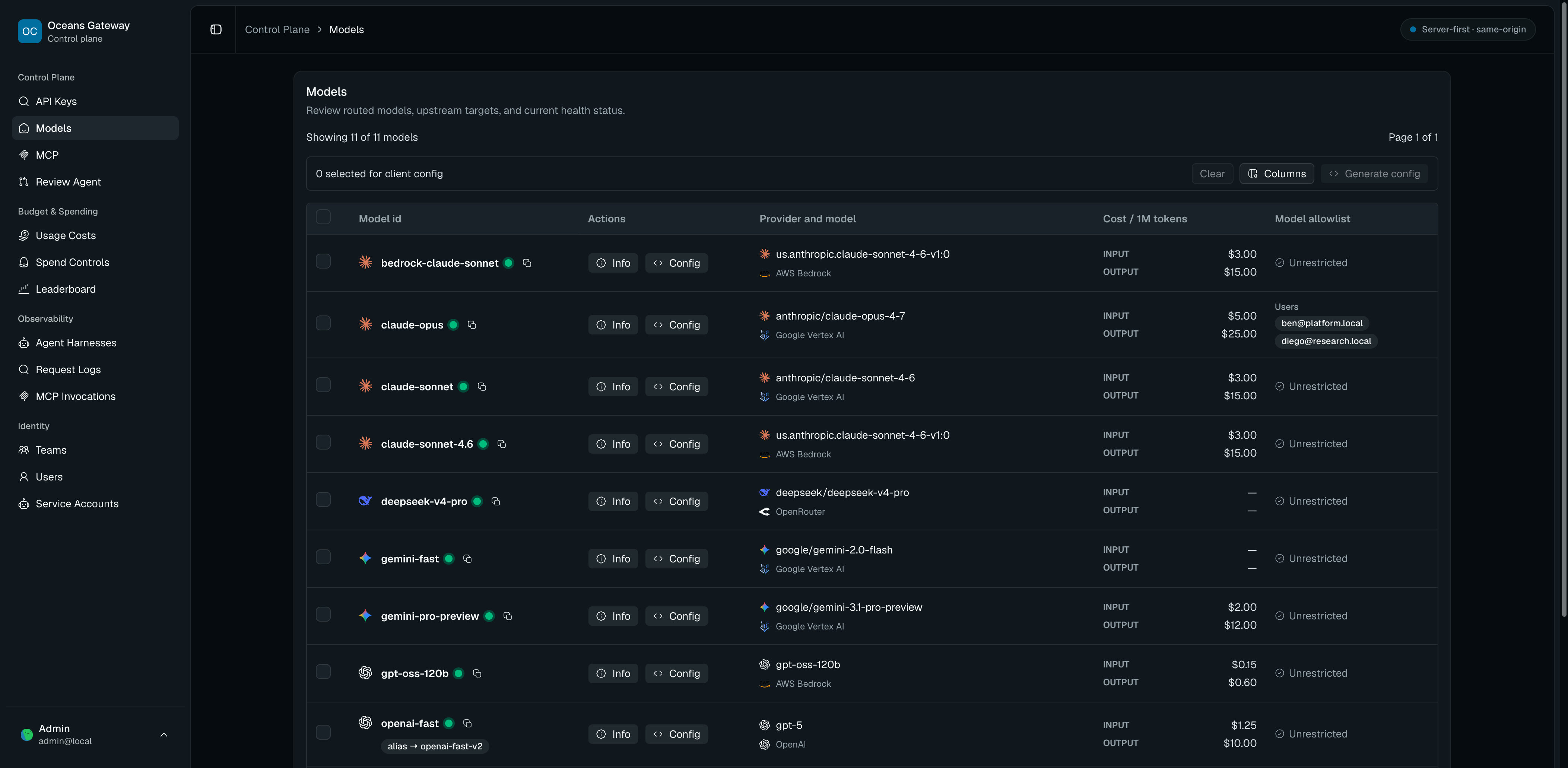
iddescriptiontagsrankroutesalias_ofallowlist
Model Allowlists
models[*].allowlist is an optional model-centric authorization policy. It answers "which human users or teams may use this gateway model?" It is separate from API-key grants and from principal-centric user, team, and service-account model restrictions.
Example:
yaml
models:
  - id: finance-gpt-4o
    tags: [finance, fast]
    allowlist:
      users:
        - Analyst@Example.com
      teams:
        - Finance
    routes:
      - provider: openrouter
        upstream_model: openai/gpt-4o
Rules that matter:
usersentries are normalized like config users: trimmed and lowercased email refs.teamsentries are normalized like config team keys.- Duplicate refs are collapsed deterministically after normalization.
- Unknown user and team refs are accepted. They are string refs so a future user or team can become effective without changing the model config.
- Omitting
allowlistmeans the model has no model-level deny policy. During config seed reconciliation for that configured model, omission clears any previously stored model-level allowlist. allowlist: {},users: []withteams: [], or refs that normalize to empty sets are invalid startup config.- A human user-owned API key may use an allowlisted model when the normalized user email or the user's effective team key appears in the model allowlist.
- A service-account-owned API key is denied for a model that has a model-level allowlist in v1, even when the owning team key appears in the allowlist.
- Aliases are independent gateway model keys. An allowlist on an alias does not inherit from the target model, and an allowlist on the target does not automatically apply to the alias.
tag:selectors evaluate effective accessible models. Allowlisted models that the caller cannot use are skipped as tag candidates.
Route Config
Important fields:
providerupstream_modelpriorityweightenabledcapabilitiescompatibilityextra_headersextra_body
Capability flags default permissively. A route can constrain provider capability. It cannot expand provider truth.
Compatibility metadata is separate from capabilities. Capabilities decide whether a route may execute; compatibility describes explicit request and stream-shape transforms for the selected provider route.
Capability flags include API-family gates such as chat_completions, responses, and embeddings, plus feature gates such as stream, tools, vision, json_schema, and developer_role.
Vertex embedding-only route:
yaml
models:
  - id: gemini-embedding
    routes:
      - provider: vertex
        upstream_model: google/gemini-embedding-001
        # google/gemini-embedding-2 is also supported for text-only embeddings
        # through Vertex :embedContent.
        capabilities:
          chat_completions: false
          responses: false
          embeddings: true
          stream: false
          tools: false
          vision: false
          json_schema: false
OpenAI-compatible route profile:
yaml
models:
  - id: fast
    routes:
      - provider: openrouter
        upstream_model: openai/gpt-4o-mini
        compatibility:
          openai_compat:
            supports_store: false
            max_tokens_field: max_tokens
            developer_role: system
            reasoning_effort: omit
            supports_stream_usage: true
            empty_tools: omit
OpenRouter route policy:
yaml
models:
  - id: openrouter-fast-zdr
    routes:
      - provider: openrouter
        upstream_model: openai/gpt-4o-mini
        compatibility:
          openrouter:
            provider:
              zdr: true
              only: [openai, anthropic]
              ignore: [deepinfra]
              order: [openai, anthropic]
              preferred_max_latency:
                p90: 2.5
              max_price:
                prompt: 1.0
                completion: 2.0
AWS Bedrock route profile:
yaml
models:
  - id: gpt-55-bedrock
    routes:
      - provider: bedrock-mantle-openai
        upstream_model: openai.gpt-5.5
        capabilities:
          chat_completions: false
          responses: true
          stream: true
          embeddings: false
          json_schema: true
        extra_headers:
          OpenAI-Project: proj_123
        compatibility:
          aws_bedrock:
            api_style: mantle_openai_responses
            openai_base_path: /openai/v1
compatibility.aws_bedrock.api_style values:
runtime_converseruntime_anthropic_invokeruntime_openai_chatmantle_openai_responsesmantle_openai_chatmantle_anthropic_messages
compatibility.aws_bedrock.supports_strict_tools is optional. When unset, Runtime Converse routes infer support from transparent upstream model IDs and omit strict for Claude Opus 4.7/4.8. Set it to false for opaque application-inference-profile IDs or ARNs backed by those models; explicit true or false overrides inference.
OpenAI-compatible profile defaults:
| Field | Default | Supported values |
|---|---|---|
supports_store | true | true, false |
max_tokens_field | max_completion_tokens | max_completion_tokens, max_tokens |
developer_role | developer | developer, system |
reasoning_effort | passthrough | passthrough, omit, reasoning_object |
supports_stream_usage | false | true, false |
empty_tools | preserve | preserve, omit, preserve_with_tool_history |
empty_tools: omit removes tools: [] from Chat Completions and Responses requests for providers such as DashScope/Qwen that reject an empty array. When an empty array is omitted, neutral tool_choice values (auto, none, or null) are omitted with it; required and named choices are rejected locally because no tool can satisfy them. preserve_with_tool_history omits an otherwise empty array but retains it and tool_choice when the request contains function-tool history, which is required by some LiteLLM/Anthropic proxy routes. The default preserve keeps existing stateless proxy behavior.
OpenRouter policy fields:
| Field | Default | Supported values |
|---|---|---|
zdr | unset | true, false |
only | [] | non-empty OpenRouter provider slugs |
ignore | [] | non-empty OpenRouter provider slugs |
order | [] | non-empty OpenRouter provider slugs in preferred order |
preferred_max_latency | unset | positive number, or object with positive p50, p75, p90, p99 values in seconds |
max_price | unset | object with one or more non-negative prompt, completion, request, or image ceilings |
compatibility.openrouter is valid only on OpenRouter openai_compat providers. Do not set both compatibility.openrouter.provider and extra_body.provider on the same route.
The current openai_compat profile fields are Chat Completions transforms. /v1/responses is a separate supported API family and is not adapted by reusing Chat Completions compatibility shims.
Do not use extra_body for compatibility transforms. extra_body remains for additive provider-specific overrides, and the typed compatibility profile remains authoritative when a declared transform conflicts with an additive override.
Route Examples
OpenAI direct routes need no compatibility overrides by default:
yaml
models:
  - id: openai-direct
    routes:
      - provider: openai-prod
        upstream_model: gpt-5
OpenAI-compatible aggregator routes should declare known Chat Completions quirks explicitly:
yaml
models:
  - id: openrouter-fast
    routes:
      - provider: openrouter
        upstream_model: openai/gpt-4o-mini
        compatibility:
          openai_compat:
            supports_store: false
            max_tokens_field: max_tokens
            developer_role: system
            reasoning_effort: omit
            supports_stream_usage: true
OpenRouter routes can also declare upstream provider routing policy explicitly:
yaml
models:
  - id: openrouter-private
    routes:
      - provider: openrouter
        upstream_model: anthropic/claude-sonnet-4.6
        compatibility:
          openrouter:
            provider:
              zdr: true
              only: [anthropic]
              preferred_max_latency: 3.0
              max_price:
                prompt: 3.0
                completion: 15.0
Vertex Google routes use the Vertex provider and a publisher-qualified upstream model:
yaml
models:
  - id: gemini-fast
    routes:
      - provider: vertex-adc
        upstream_model: google/gemini-2.0-flash
        capabilities:
          chat_completions: true
          responses: false
          embeddings: false
Cloud Run vLLM routes use the Cloud Run OpenAI-compatible provider and can set tested vLLM/Gemma request controls through extra_body:
yaml
models:
  - id: gemma-cloud-run
    routes:
      - provider: gemma-cloud-run
        upstream_model: google/gemma-4-12b-it
        capabilities:
          chat_completions: true
          responses: false
          embeddings: false
        extra_body:
          chat_template_kwargs:
            enable_thinking: true
          skip_special_tokens: false
Bedrock routes can execute Chat Completions through Claude native Messages, Converse, and ConverseStream depending on the upstream model and request shape. Keep Responses and embeddings disabled:
yaml
models:
  - id: claude-bedrock
    routes:
      - provider: bedrock
        upstream_model: us.anthropic.claude-3-5-sonnet-20240620-v1:0
        compatibility:
          aws_bedrock:
            api_style: runtime_converse
        capabilities:
          chat_completions: true
          responses: false
          embeddings: false
          stream: true
          json_schema: false
OpenAI-compatible embeddings-only routes should narrow route capability so chat and Responses requests fail early:
yaml
models:
  - id: text-embedding
    routes:
      - provider: openai-prod
        upstream_model: text-embedding-3-small
        capabilities:
          chat_completions: false
          responses: false
          embeddings: true
          stream: false
Validation and Failure Boundaries
Config load catches these failure classes up front:
- invalid or empty provider fields
- unsupported pricing-provider mappings
- invalid alias references
- invalid route or provider wiring
Later failures are runtime problems such as:
- request resolution failure
- missing providers
- capability mismatch
- exact-pricing gaps
Current Boundaries
- Declarative teams, password users, OIDC users, memberships, active budgets, and OIDC providers are part of the current seed contract.
- OIDC JIT defaults are provider configuration. They do not map claims or groups.
- Existing password users are not auto-linked to SSO users by email.
What This Page Does Not Own
- startup behavior and first access:
- request routing and
/v1/*behavior: - cross-cutting request cause and effect:
- spend windows and budget policy:
- OIDC and SSO behavior: